Rakazo Review: An Open-Source Grok Bot Alternative With No Free Hosted Tier
Evidence note: everything below comes from a hands-on session on 22 November 2026, recorded in an internal run log. Prices, plan names, page text and error messages were observed on Rakazo's own site, its app and the Dub partner pages. Anything not observed is marked as such. We stopped before entering card details: no subscription was made, no bot was created, and no self-hosted instance was run.
The short answer
Rakazo's code is open source and you can self-host it for $0 — but there is no free hosted tier. The hosted own-key plan starts at $15/month, and its 7-day trial requires a card up front. If you want a managed bot that runs scheduled routines without paying, this is not it. If you can run your own server and bring your own model key, the license cost is zero.
What Rakazo is
The homepage headline reads: "The open source Grok Bot alternative you actually own". According to that page, the project is Apache-2.0 licensed and shows 9.4k GitHub stars.
The product is built around teams of bots. Each bot gets its own computer, and you can give it scheduled routines; MCP and integrations are also advertised on the homepage. That is the pitch: a Grok-style bot you control, with its own workspace and a way to run recurring jobs.
That is as far as the public positioning goes in our notes. We did not create a bot, run a routine, or test an MCP connection, so this review makes no claim about how well those features work in practice.
Pricing, as listed
| Option | Price shown | Notes from the page |
|---|---|---|
| Self-hosted | Free | Bring your own model / API key |
| Own-key hosted | $15/month | $12/month billed annually; 7-day trial includes $3 of computer time |
| Rakazo credits | from $20/month | — |
| Pro | $49/month | — |
| Max | $99/month | — |
| Ultra | $199/month | — |
The pricing page also noted $5/month of computer time on the Standard tier. Inside the app's onboarding, the credit route was presented as starting at US$30/month, with the full $30 going toward model usage. We did not test how computer time is metered or what happens when it runs out.
The important line in this table is the first one. Self-hosting is free in license terms, but the hosted product has no free plan — only a trial that converts to a paid subscription.
Signing up: the strongest first-hand evidence
Registration itself is frictionless. The app redirects to /sign-up, which offers three entry points: Google, Apple and email.
We took the email route:
/sign-up/emailasks for a name, email address and password.- The submit button performs account creation — it is not a "continue" step. (Our first attempt clicked what looked like a continue action and did nothing; the actual submit had to be triggered.)
- After submission we received two emails: a verification email and a welcome email.
- The verification email contained a single magic link and said it would expire in one hour.
- Opening that link signed us straight into
/app.
There was no CAPTCHA or Turnstile challenge, no phone verification, and no card asked for at registration. The account menu showed the registered email address with working account and sign-out options, so the account itself was usable. This is a genuinely clean signup flow, and it is the part of Rakazo we can confirm end to end.
Where the paywall starts
The paywall is not at signup. It is the gate in front of the bot interface.
After verifying the email, onboarding asks "Choose how you want to use Rakazo" and offers two choices: an own-key / subscription plan starting at $15/month with a 7-day trial, or a credits option starting at US$30/month with the full amount used for model usage. There was no free hosted option on that screen. Without completing one of these paths, we could not get into the main bot interface.
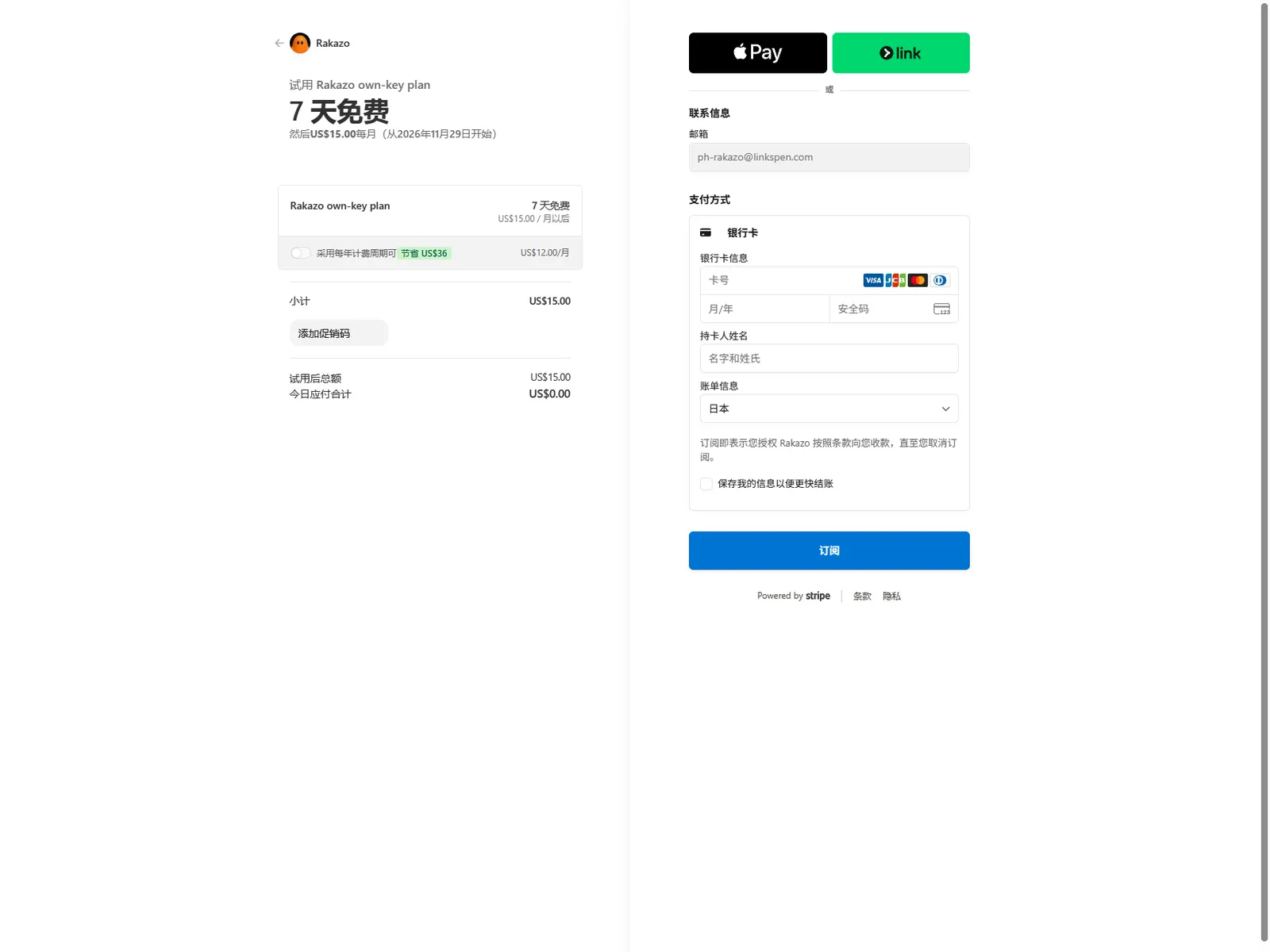
We clicked the 7-day trial. That led to Stripe Checkout, on the own-key plan, with the billing country defaulting to Japan. The trial line read, in the page's Chinese text, that the first 7 days are free and billing starts on 29 November 2026 at US$15.00/month. The card form accepted Visa, JCB, Mastercard, Amex, Diners Club and Discover, and asked for no phone number.
We stopped the moment the card form appeared. No card number was entered and no subscription was completed. Anything after that point — the trial actually starting, bots being created, scheduled routines firing — was not observed and is not claimed here.
Backend routes we could not find
Before paying, we tried to reach the self-service settings that an own-key plan would need. These paths all returned a not-found page:
/settings/settings/api-keys/settings/models/settings/account/api-keys/bots
We did not find a self-service API key entry point. The honest conclusion is limited: on the account we had, before completing paid onboarding, those routes were not reachable. The own-key path appears to require finishing the paid onboarding first or going the self-hosted route. We cannot say the features do not exist — only that we could not find them from where we stood.
Affiliate program: background only
Rakazo's own /affiliates/ page is a soft 404: "The page you requested does not exist." The footer Affiliates link actually points to a Dub partner page at partners.dub.co/inboxzero/rakazo — the program owner slug still says inboxzero.
That Dub page advertises "Join the Rakazo affiliate program" and "Earn 25% per sale for 1 year". Its calculator shows $75/month based on ten $30 sales at 25%. This is an application program, not an instant link: step 1 of 2 asks for name, email, website, a description of promotion plans, two checkboxes and acceptance of the Program Terms. The application copy itself still refers to the Inbox Zero program.
Payout fine print from the Dub Partner Terms: a program can set a minimum payout threshold — "If the Partner Program has a minimum payout amount set, your payout amount will need to reach the threshold to become eligible for payment." Payouts require Stripe Express/Recipient or PayPal, processing can take up to 5 business days plus 1–14 business days to reach a bank, and Veriff identity verification may be requested. The cookie window is not disclosed on the public pages. No application was submitted for this review, and this article uses no affiliate link.
Who it is for
Fits:
- Developers comfortable running a self-hosted service and supplying their own model API key
- Teams that want bot teams with dedicated per-bot computers and scheduled routines, and can pay for hosted capacity
- Anyone who values an Apache-2.0 codebase they can inspect and own
Does not fit:
- Anyone looking for a free hosted bot with no card on file — there is none
- Users who want to evaluate the bot interface before paying; onboarding blocks the way
- People who expect to configure API keys in account settings; those routes were not found pre-onboarding
- Those who need a clear public affiliate cookie window before promoting the product; it was not disclosed
Verdict
Rakazo is genuinely open source at $0 to self-host, and the signup flow — Google, Apple or email, with a magic link and no phone or CAPTCHA — is one of the smoothest we have seen. But the hosted side draws a hard line before the bot interface: choose a plan, and for the trial, attach a card. We reached the Stripe card form and stopped. Self-hosting is the only $0 path we can confirm from the pricing page; we did not run it, and we did not run a bot on either path.